Welcome to my Compost Blog!
I plan to offer a wide range of discussions here. I hope you find what you need but if not just ask and I’ll respond or point you in the right direction.
May 10. 2012
Compost Road Show
This week and next I’m traveling through seven Ozark counties delivering 14 programs to both elementary and secondary students. I’m excited about this for several reasons.
First It’s been almost a year in coming as I wrote the specifications for this grant, bid on this grant and won this grant over a 10 month period. It’s the first time in my 22 years of educating about the environment that i’ve gotten to present an all-compost assembly.
Second, the program includes two special features that were designed and developed just for this event. One is The People Pile.
It’s a skit in which kids play the ingredients of a compost pile, the greens, browns, bacteria, water and heat. There’s a narrator and a magic composter kid who has the bright idea to see what happens when you pile up organic materials. So far the skit has been going well and the audiences like seeing a play by their classmates.


The second special feature is a worm observation live on a big screen using a USB powered microscope through my computer.

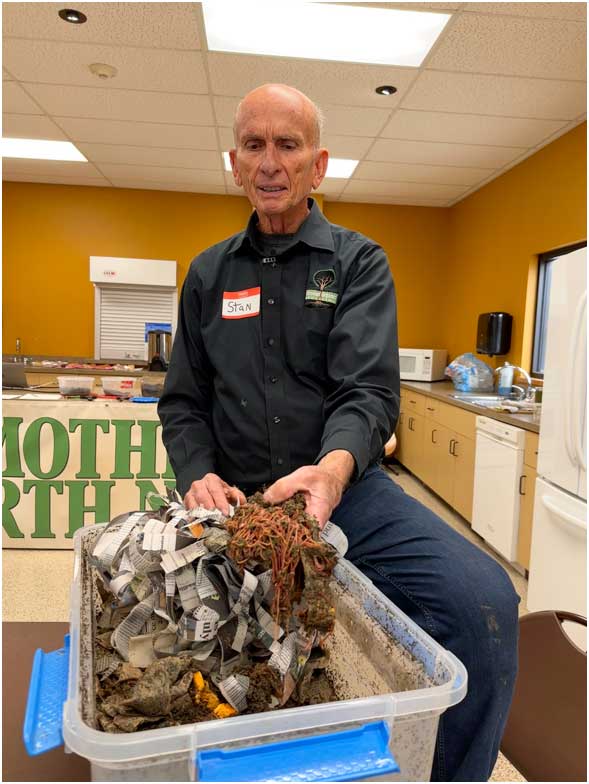
As I present the value of worms in composting, I finish by putting the microscope on a worm colony showing adult worms, their transparent babies and their fellow denisens of a worm colony.
Some of the most fun programs have been to Agriculture classes. My perspective is very different than the teacher's but often brings out some interesting synergies. The students really enjoy the music and the fun topic of composting.

May 3, 2012
Compost hits the Road!
Earlier this spring I launched a new service called Sudden Gardens. It's designed for people who want to garden but don't have the time, equipment or know-how to get started.

I provide 5-600 pounds of compost, a bag of pelletized gypsum to help break up clay soils, a bale of straw to mulch the garden plants and a bag of organic fertilizer.

I

till the garden, apply the compost and gypsum and then till the compost in. So far I've done 5 gardens and it's very satisfying.

I'm looking forward to the "harvest" photos of the veggies my clients are able to grow.
I love demonstrating the power of compost to change soils for the better. Somone even suggested that I franchise the service. It's too early for that but it is heartwarming to see the response folks have to my work.

October 7, 2011
I'm expanding an old garden bed to better use the sun in our yard. I've used a garden hose to draw the outline of the bed and dumped almost two cubic yard of our municipal compost on this bed. I used the garden hose to outline the new perimeter and then dumped wheelbarrow loads of compost all over the new area.
I then tilled it up only about three inches deep. This killed the grass and mixed in the first layer of compost. Next week I'll be adding another two yards of compost plus some gypsum, sand and maybe peat moss. I'll also add some charcoal that has been soaked in compost tea. Then I'll till a full six inches deep and condition all the soil for growing some real produce.
The lower end of this bed is poorer soil. You can probably see the lighter color. Probably it's from the disturbance when the yard was graded during construction. I'll load this area with even more compost. I'm thinking of digging small pathways into the bed and raising the soil into a mandela pattern.
There's a red quince bush and a pretty big apricot tree in the bed, too. I'll dig them up and give them to friends. The sunny space is too valuable to have a tree limiting the vegetables I can harvest. This year frost took out the entire fruit crop.
You may also notice the Solar Cone (the green pyramid thing) in the upper pictures. It is a way to fertilize the garden using food scraps and never having to compost or have insect problems. The compost tea from this device, while fairly deep in the ground, is available for plant growth and it can't hurt.
That's it for now. I'm planning some big changes in my compost pile for November so stay tuned for more composting tips.
July 8, 2011 Watch this video on compost pioneer, Malcolm Beck.
Here
February 25, 2011
There's not much composting happening outside as today's high is 29 degrees, but inside our new greenhouse there are lots of little green guys getting ready for the spring.

I built the greenhouse when my neighborhood association reminded us that our plastic hoop house didn't meet the covenants of the neighborhood.
At first I was miffed, but then I realized that the greenhouse I planned

would be even more flexible in helping our food production. Fortunately my worm bins had a ready supply of vermicompost and today I gave all the baby kale and spinach some real nutrition. There are still some details to work out but there are lots of plants growing now and lots more on the way. This greenhouse has the disadvantage of having more framing and not as much light as the hoop house, but it also doesn't get as hot in the summer. It gets plenty warm in the winter.
February 1, 2011
Hi Everyone! Linda and I have returned from the US Compost Council Convention and we feel like we've "Been to the Mountain!" There were over 1000 attendees over four days! We were both impressed with the quality of the presenters and the amazing developments in the field of Organic Recycling.
Composting food residuals along with utensils and containers was a big theme. The conference was striving for zero waste. Recycling and composting bins were everywhere. Many of the booths were offering biodegradeable plastic bags and compostable table wear of all kinds.
Vermicomposting was also featured as a value-added means of organic recycling. Large institutional vermicomposting machines were prevalent in the booth area. These are the kind of tools that a school, restaurant or jail could use to recycle its left over food. In case you didn't know, vermicompost is something like ten times more potent than regular compost with other great qualities including the ability to stop mold and fungus in seedlings.
On the 24th I presented my workshop: Compost Outreach-Best Practices in Compost Education. Though the group was small, they were some high-powered folks. One of my favorites was
Angus Johnston, National Project Manager for Compost Australia.

His group coordinates education and development of composting throughout the country. Other attendees were associated with California's composting agency, Cedar Grove Composting of Seattle, Proctor and Gamble's packaging group and Stanford University. The good news is that they liked the workshop and learned some new tools to teach children and the public about the wonders of compost.
January 21, 2011
We're off Sunday to Santa Clara to present at the US Compost Council's annual convention. It's a 3.5 hour workshop Monday on Best Practices in Compost Education. Linda and I are both really excited as we're got a skit, some songs and some great information about the process of creating Organic Literacy in the public. It will be great to get back there eleven years since I was awarded their Compost Educator of the Year award in 2000. It's a huge deal with over 1,000 attendees. We'll have fun, you do the same.
Compost: The Metaphor
Compost is the Answer-What was the question?
Compost seems to be at the crossroads of many important ideas today. Soil fertility, vibrant healthy food, waste disposal, sanitation and sustainability all have deep roots in the concept of compost.
In a world dominated by the one-way extractive paradigm, Composting is focused on putting back, on restoring. The more advanced our organic farming and gardening systems become, the more central the concept of returning what is taken becomes.
Sir Albert Howard, the father of modern composting, spoke of the Law of Return. Its essence is that healthy vital soil can give us vibrantly healthy food from its bounty. If we destroy that bounty by failing to replenish what we’ve taken, the quality of the food we extract will fall. Lacking the reserves it needs, Nature will withhold its best from crops leaving them prey to pests and diseases. This causes the weak crops to be recycled into humus to rebuild the soil’s bounty. Only when fully rebuilt will the soil’s health and vigor be returned and available for use.
You may ask, “But we’re getting crop after crop from modern farm fields, what evidence is there that the soil is not healthy?"
The difference is quality not quantity. All one has to do is to taste the sweetness and full flavor of food grown in vital soil. Most Americans have never been able to compare their food to organic. As one who stays organic most of the time, I can tell you it's easy to taste the difference in most foods. Animals also know the difference. There's the story of rats that broke into the granary and ate all the organic food without touching the regular chemical fertilized stuff.
What Causes This Difference? Coming soon
My composting experience.
I’ve been an educator all my adult life, and about 30 years ago, I got serious about composting. As a 4-H farm boy, I didn’t know about compost, but I did know about organic recycling. I loaded the manure spreader many times. My uncle filled holes with food scraps all one summer and grew the best tomatoes in the family on those same spots the next year.
After 11 years as a science teacher (with a Masters in Biology) my first real composting experience came outside the classroom. Moving to a rural area, I found I needed to protect my water source from contamination, so I researched and built a composting toilet. Soon, I was building them for others, and publishing a guidebook on how to do it.
In 1991, I proposed a composting education project for the Kansas City, Missouri region. That composting education project was funded by a collaboration of the Hallmark Foundation, Kansas City Power and Light, and KC’s Waste Minimization Commission. I made 238 public appearances the first year, speaking at Lion’s Clubs, Lawn & Garden shows, and lots of schools. By the second year we had the Compost Trailer (see photo) outfitted and traveling with me. 
Since that first year, composting education and teaching recycling and other waste reduction strategies has been my full time job. It’s taken me to 25 states and thousands of schools. My clients have been cities, states, counties, schools, and solid waste management agencies all over the country. To help me in educating kids and adults about compost, I’ve developed the products you see here on the web site and delivered scores of workshop. My guitar has never been far behind.
Singing about compost sounds pretty strange but it’s a great way to shift the mood and get a crowd warmed up to the message.
I’m interested in your situation and the ways you use compost in your area. That’s one of the ways that I’ve been able to learn the most. Please let me know if this site doesn’t have the answer you are looking for. I’d like to help. Contact me directly about compost workshops, compost keynotes, and compost questions.
Thanks very Mulch,
Stan Slaughter
America’s Eco-Troubadour